|
POSTERS ON THIS SITE |
||||||||||
|
|
|
|
|
|
|
|
|
|
||

In Celebration of 1936, "Workers of all countries, unite!" |
|
This poster, commemorating industrial advances in 1936, urges, “Workers of all countries, unite.” Among its articles on Stalin, Wikipedia says of The Industrialization movement during the years from 1932—1942: “Stalin's "Five-Year Plans" called for a highly ambitious program of state-guided crash industrialization and the collectivization of agriculture. With seed capital unavailable because of international reaction to Communist policies, little international trade, and virtually no modern infrastructure, Stalin's government financed industrialization both by restraining consumption on the part of ordinary Soviet citizens to ensure that capital went for re-investment into industry, and by ruthless extraction of wealth from the kulak landowners.
“Common and political prisoners in labor camps were forced to do unpaid labor, and communists and Komsomolsk members were frequently "mobilized" for various construction projects.
“The Soviet Union used numerous foreign experts, to design new factories, supervise construction, instruct workers and improve manufacturing processes. 521 factories were built between 1930 and 1932. In spite of early breakdowns and failures, the first two Five-Year Plans achieved rapid industrialization from a very low economic base. While it is generally agreed that the Soviet Union achieved significant levels of economic growth under Stalin, these gains were accomplished at the cost of millions of lives.
“Historians agree that Five-Year Plans during these years substantially helped to modernize the previously backward Soviet economy. New products were developed, and the scale and efficiency of existing production greatly increased. Some innovations were based on indigenous technical developments, others on imported foreign technology. Despite the great costs, the industrialization effort allowed the Soviet Union to fight, and ultimately win its WWII conflicts.” |

|
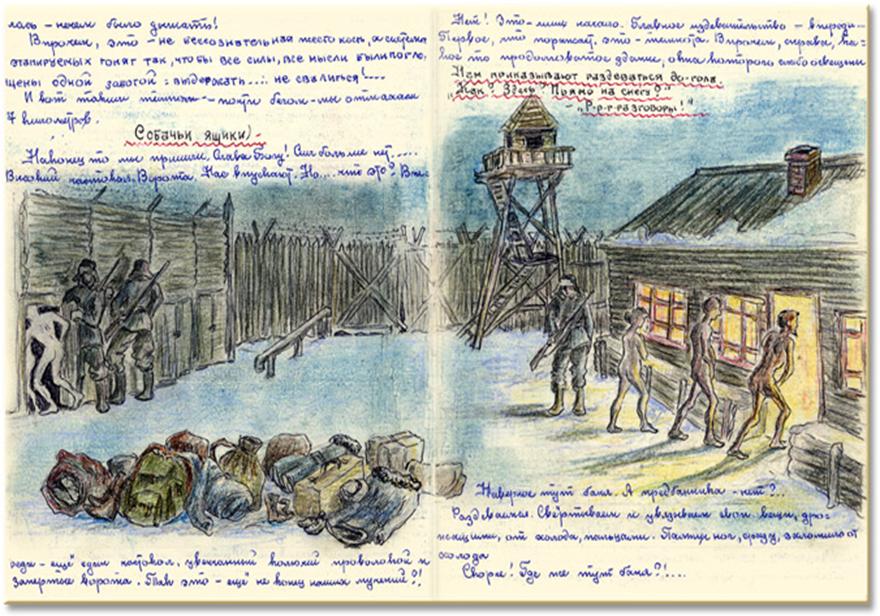
BELOW: An entry called, “On the Railroad” from one of the 12 journals of Eufrosinia Kersnovskaya. The journals describe her life during 1939—1952. She spent 12 years in Soviet prisons because she was the daughter of a Ukrainian landowner. She produced 680 drawings of her recollections.
|
|
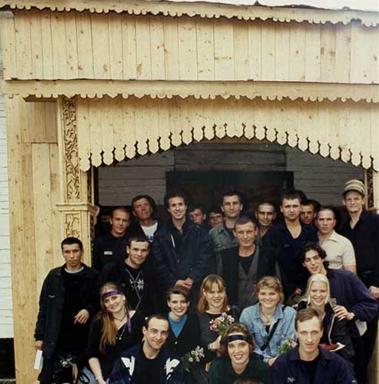
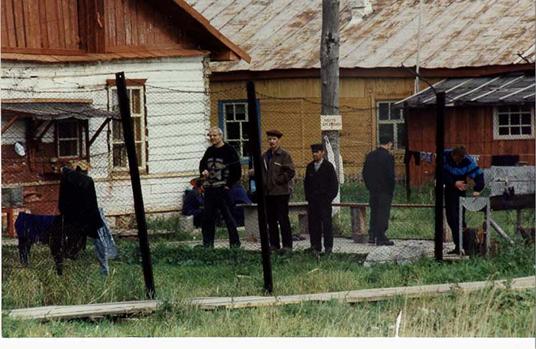
UPPER LEFT: Many labor camps, “Gulags”, like this one, although now somewhat more humane, are still in operation. It is not uncommon for political and other prisoners to be housed in camps like this one. This camp is located near the Ural Mountains. You can see some of the prisoners standing on the walkway. LOWER RIGHT: In this group picture, the girls you see in the second row of the lower photo and the men with longer hair are visitors. BELOW: Compare the idyllic 1936 poster with Kersnovskaya’s entry, “Entering Labor Camp”
|