


|
POSTERS ON THIS SITE |
||||||||||
|
|
|
|
|
|
|
|
|
|
||
|
LINKS TO MORE OF PUSHKIN’S WORKS: Free eBooks by Project Gutenberg "The Land of Moscow..."From "The Reminiscences at Tsarskoe Selo" The Tale of the Fisherman and the Fish The Tale of Ruslan and Ludmila The Tale of Tsar Saltan (full text with original 1831 artwork)
|
Alexander Pushkin: Father of Modern Russian Literature |
|
Translated sample of Pushkin’s poetry: To the Bust of the Conqueror
1829 In vain, you’re seeking errors here:The hand of art has camouflagedThe marble of lips with a smile, smeared,Ice of a brow - with a rage…In fact, this image is two-faced.The same was and that mighty king:Used to his soul’s controversies,A face and life – of Harlequin. Translated by Yevgeny Bonver, July 10, 2004
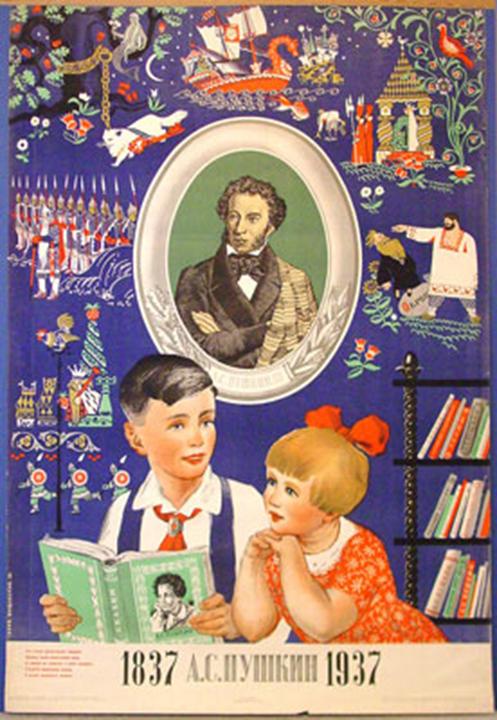
This commemorative poster honoring Alexander Pushkin shows scenes from his fairy tales. Even though he lived nearly 200 years ago, his tales are still among the most loved of all Russian stories. There are links below to translations of many of his works, and even today, new translations are being released, and translators still vying to produce the finest Pushkin translations. Even 1950’s adaptations of Pushkin’s stories to Soviet television hold even the most casual viewers in rapt attention. According to Wikipedia writers: “Alexander Pushkin is seen as having originated the highly nuanced level of language which characterizes Russian literature after him, but he is also credited with substantially augmenting the Russian lexicon. Where he found gaps in the Russian vocabulary, he devised calques. His rich vocabulary and highly sensitive style are the foundation for modern Russian literature. His talent set up new records for development of the Russian language and culture. “He became the father of Russian literature in 19th century, marking the highest achievements of 18th century and the beginning of literary process of 19th century. Alexander Pushkin introduced Russia to all the European literary genres as well as a great number of West European writers. He brought natural speech and foreign influences to create modern poetic Russian. Though his life was brief, he left examples of nearly every literary genre of his day: lyric poetry, narrative poetry, the novel, the short story, the drama, the critical essay, and even the personal letter. From him derive the folk tales and genre pieces of other authors: Esenin, Leskov and Gorky. His use of Russian language formed the basis of the style of novelists Ivan Turgenev, Ivan Goncharov, and Leo Tolstoy. “Alexander Pushkin became an inseparable part of the literary world of the Russian people. Translated into all the major languages, his works are regarded both as expressing most completely Russian national consciousness and as transcending national barriers. Pushkin’s intelligence, sharpness of his opinion, his devotion to poetry, realistic thinking and incredible historical and political intuition make him one of the greatest Russian national genii.”
|
|
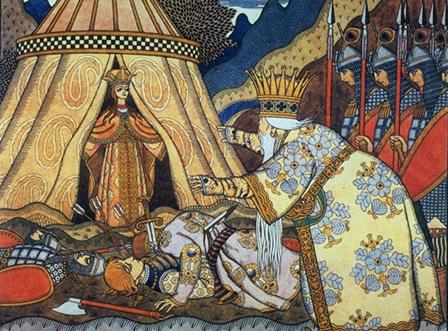
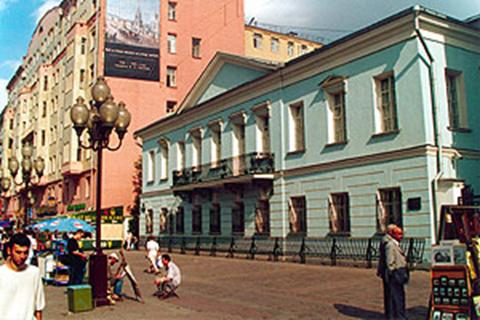
UPPER LEFT: Tsar Dadon meets the Shemakha queen (illustration to The Tale of the Golden Cockerel, 1906) Artist: Ivan Bilibin The soldiers in Bilibin’s painting are like those pictured on the commemorative poster. The other drawings on the poster depict scenes from some of Pushkin’s other tales. LOWER LEFT: The blue Empire-style house on the Arbat was home to Pushkin for a short time in the spring of 1831.The museum houses various pieces of original furniture from the Pushkins' apartment and exhibits an array of original manuscripts and first editions of the writer's works. |
|
Address: |
Ulitsa Arbat 53, Moscow |
|
Tel: |
(095) 241-9295 |
|
Metro: |
Smolenskaya |